
Another Attack on British Streets
What “Open-Minded” Leadership Is Costing Us

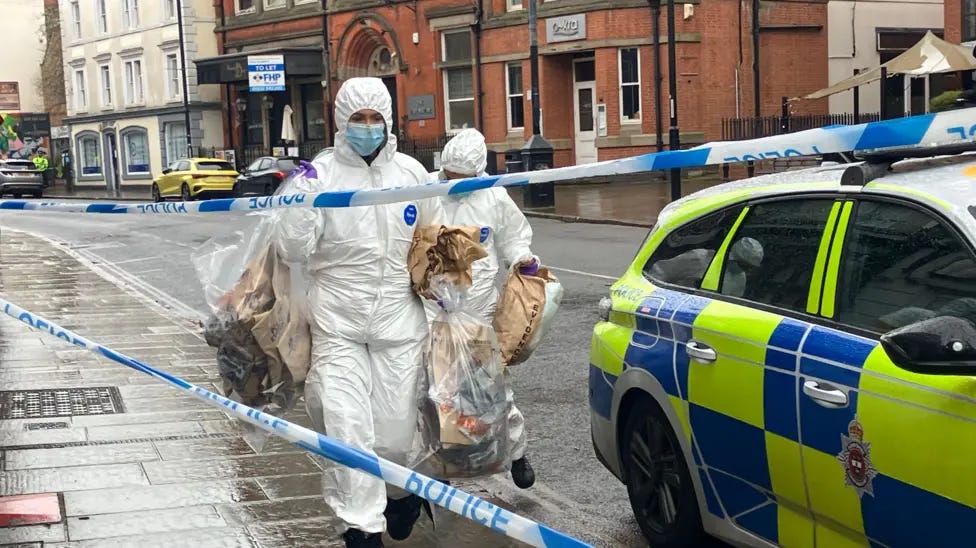
Saturday night on Friar Gate in Derby should have been unremarkable, the sort of evening that comes and goes without notice. Instead, seven people were left injured, some of them seriously, after a black Suzuki Swift drove into them at around 9:30pm. A 36-year-old man, originally from India and living in the UK for several years, was arrested on suspicion of attempted murder. Counter Terrorism Policing are involved, described as routine for an incident of this kind. The official line is familiar. Police say they are keeping an open mind about motive and are not treating it as terrorism at this stage.
This is the problem. Now is not the time to keep an open mind, and it is not the time for bureaucracy or diplomacy. Things are getting out of hand. What exactly are you keeping an open mind about? Whether it fits some technical or legal definition does not matter anymore. I could not care less.
This is terror. It does not need a long investigation to see that. These acts are increasing, and they are inflicting fear first on those injured, then on those who witness it, and then on all of us watching. People are starting to accept a reality where we are not safe anywhere.
One minute you are shopping or spending time with friends, and in an instant your life is changed forever or taken entirely. That is the reality.
Politicians and police continuing to dance around this, hiding behind laws and careful language, are not helping anyone.

What deepens the unease is how early we are in the year. We are only just approaching April, yet the pattern is already clear. Still, there remains a reluctance among political leaders to speak plainly about the scale of the threat. Energy is directed elsewhere, often towards symbolic debates or historical grievances that feel distant from the immediate concerns of people living their daily lives. Meanwhile, incidents unfold here and now. People are attacked on British streets. Communities are targeted. The gap between political focus and lived reality grows wider by the month.
The first months of 2026 already offer a stark picture. In January, a 21-year-old from Bristol, Mohammed Mohamoud, was arrested on suspicion of attempting to join Islamic State after travelling to Somalia and spending time in territory linked to its regional affiliate. A search of a residential address led to the involvement of a bomb disposal unit on a quiet street. In the same month, another 21-year-old was given a life sentence for planning an attack on a major shopping centre, having gathered weapons and obtained instructions relating to chemical agents. These are not distant threats or abstract risks. They are concrete plans, formed and pursued within this country.
February brought further developments. Two men were sentenced for a plot prosecutors described as potentially the deadliest attack on British soil since 7/7. Their plan involved opening fire with automatic weapons on a large gathering of Jewish civilians before moving on to a military base. One was Tunisian-born and living in Wigan, the other a Kuwaiti national. Together they received a combined minimum sentence of 63 years. By the end of last year, 267 individuals were in custody in Great Britain for terrorism-related offences, the highest figure recorded. Against that backdrop, the instruction to keep an open mind begins to sound less like caution and more like avoidance.
Public frustration does not come from nowhere. People can see patterns, even when no one wants to name them. They can see that different waves of migration have had very different outcomes, and yet that conversation is constantly avoided. Earlier generations, from the Caribbean, from India, from East Africa, came here and built lives without bringing this kind of ongoing security problem with them. There were challenges, of course, but they were not like this.
The reality around us today tells its own story. The counter-radicalisation programmes, the heavy police presence, the barriers at public events, all of it exists for a reason. None of that was put in place because of those earlier communities. People know that. They see it every day, even if they are told not to say it out loud.
At the centre of all this is something that has been avoided for far too long. There are specific beliefs and ideologies that have taken hold in certain places, and governments have chosen to manage them quietly rather than deal with them properly. That choice has a cost.
You see that cost in places like Derby. You see it in lives disrupted or destroyed. You see it in the growing sense that things are slipping and no one is being straight about why. And the people paying that price are not the ones making the decisions. It is ordinary people, going about their lives, who are left to deal with the consequences.
Those most directly affected are rarely the ones shaping the policy. They are people going about their daily routines, often in areas with fewer resources and fewer options to relocate or insulate themselves. They experience the consequences in immediate and practical ways, while the broader conversation unfolds at a distance, filtered through commentary, analysis, and debate. This creates a disconnection that is difficult to ignore, particularly when those urging calm and restraint are often removed from the environments where these incidents occur.
Raising these concerns still carries a social cost. It is common for such discussions to be framed as divisive or alarmist, which has the effect of narrowing the space for honest engagement. Yet the underlying facts remain. Arrests, plots, convictions, and attacks continue to accumulate. These are not perceptions shaped by rhetoric. They are events that have taken place, each one contributing to a broader sense that something is shifting in ways that are not being fully addressed.
For many people, the issue comes down to something straightforward. Safety is expected to be the most basic guarantee a state provides. When that expectation begins to weaken, trust follows. The conversation then moves beyond policy details into something more fundamental, touching on responsibility, accountability, and the limits of what can be deferred. There is a growing feeling that delay carries its own risks, and that clarity, however uncomfortable, would at least offer a sense that the problem is being faced directly.
In Derby, families are dealing with the immediate aftermath of what happened on Friar Gate. Their concerns are immediate and human. They are not thinking in terms of definitions or classifications. They are thinking about recovery, about uncertainty, about what comes next. That perspective, grounded in lived experience, sits alongside the broader national conversation, and it brings a certain sharpness to it. It reminds us that behind every incident is a reality that cannot be softened by language or deferred by process.
The pressure building around this issue is unlikely to dissipate. It reflects a wider demand for clarity and for action that feels proportionate to the scale of the problem as people perceive it. Whether that demand is met, and how it is met, will shape not only the immediate response but also the longer trajectory of public trust.
Subscribe if you value this. Upgrade your membership if you want to support the channel directly. It keeps this work going.
Thank you for writing this Ada. Politicians and police need to be honest about these attacks. They think WE don't know what is going on. We're Living on tenterhooks wondering when we'll be next. The politicians think they can manipulate the message but we're experienced now post Covid. Civil unrest is brewing.
Great article, Ada. Sadly this attack was near to me. The Police and establishment need to stop being cowards. It's a particular ideology that causes these incidents.
Innocent people's lives can't keep being put at risk for the sake of "political correctness"
This is madness. It makes me feel unsafe to just go out the house